Thursday, September 22, 2011

There and Back Again - the Wrap Up

We left Neah Bay, WA on September  7, 2010 at 11 am beginning our adventure to Baja. We returned to Neah Bay on July 27, 2011 at 11 pm having travelled over 11,000 nautical miles. On the way south we stayed from 50 to 90 miles off shore.


Our Route from La Paz to Hawai'i and on to WA


Our route from the tip of Baja to Hawai'i followed the Trade Winds. Once past the Hawai'ian Islands we sailed around the Pacific High. The first passage to Hawai'i took 16 days and the second back to WA took 22.

I wondered if I would have an opportunity to witness the great "garbage patch" in the north Pacific gyre first hand. We successfully avoided entering the high (unlike some of the other boats we were following) and didn't see it but others who were sitting becalmed in the center of the high didn't see it either. In a way I am glad, because it would have been a very depressing sight. At our rendezvous in Poulsbo, WA last week I discussed the problem of plastics in the ocean and the garbage patch and I was surprised to find several sailors who had no idea it existed and wanted to know who put it there.

Of the 11,000+ miles we covered, we sailed about 8,000, based on fuel consumption of 498 gal. of diesel. Using a  rough estimate of  four dollars per gallon, we spent $1992 on fuel. Our food costs were less than they would have been in Washington since the food in Mexico is much less expensive. We ate at restaurants very in frequently and when we did it was usually lunch. Our "entertainment" costs were less than $200 and included renting a car on Hawai'i (which was more for provisioning) the fees for the La Paz museum, various small donations and the Bishop Museum in Honolulu. We're a frugal couple.

I over provisioned, no surprise to Greg, and returned with much of what I took - BUT we didn't want for food! Almost everything you could want is available. In Baja, where refrigeration is rare in the villages, the vegetables can be a little limp and in Hawai'i they are EXPENSIVE but they are there. Wine and some forms of spirits are hard to fine in Baja outside of the major cities.

Everyone seems to want to know about sailing on the open ocean. It was less dramatic than I had anticipated. Greg's use of the grib files (wind speed  & direction, wave height and barometric pressure), weather faxes and the net forecasts keep us out of nasty situations. We were careful and didn't take any shortcuts. We only encountered overcast skies and a few squalls. Our most exciting weather experience was in Baja when we sailed through a lightning storm and had a sudden down draft of over 70 knots. For the most part we sailed between 5 and 7 knots per hour. We only had one day where we were close to becoming becalmed and it only lasted a few hours. Our friends on Cadence were becalmed twice - for five days each time. Since you have to be careful to allocate your fuel, you can't just motor your way out of it.

Pacific squall

Night sailing in a moonless sky was stressful the first two nights but it became routine as I realized that there weren't any ships around and I couldn't do anything about the small stuff. My idea of using forward-facing sonar to see cargo containers and sleeping whales didn't pan out. They are too close to the surface and are lost in background "noise". The AIS on the other hand was worth every penny we paid for it and took the tension out of "meeting big ships". It told us exactly where ships were and what the closest point of approach would be.


The best part of passage making, as far as I am concerned, is the 360 degree sunrises and sunsets. You just can't experience this anywhere else (except maybe on Mt Everest).

Comocean, a Catalina 42' sloop with wing keel,  turned out to be a very capable and fast "blue water cruiser" even though it wasn't designed to be. We had very few problems which I attribute to the great care and thought that Greg puts into her upgrades and maintenance. The fresh water pump was our first problem. When it failed we just switched to our redundant pump (it still needs to be replaced). We had a voltage regulator fail and had one flown into Mulege (we should have been carrying a spare). We had some sail problems: Our 19-year-old main sail tore but Greg was able to pull it through the center window and repair it with his Sailrite sewing machine (a new one is on order this year). Our Yager spinnaker, which did a phenomenal job, came undone once at the top and once at the bottom due to parts that weren't up to the task (we know the problem and are fixing them) and Sonia promises not to fly her kite in 20 knot winds.

Two issues were actually related to sailing offshore: the autopilot and the rudder thrust bearing . The pounding we took at sea and a bad stop had caused the autopilot to overextend. This allowed some retainer pins to drop out of place consequently allowing the magnet portion of the clutch to turn. This caused two little wires to twist until they broke. Fortunately for us they broke far enough out to allow Greg to splice them. Even tough Raymarine

Autopilot repair

Did we enjoy our travels? Yes, most definitely. We proved that it isn't really possible to do the round trip every year like we had originally planned but after a year or so to rest up we will be heading back south again. The boredom of the passages is still a problem for me but I will continue to try to find a way to solve it.
The cast of Characters:


Cinnamon in a rare "awake" moment

Cinnamon in his usual state

Greg and Mahi Mahi

Sonia

I have  been convinced to continue this blog by friends who have enjoyed it. I will post new blogs each time we do something new or especially noteworthy.


Wednesday, August 24, 2011

What We Didn't Tell/Show You of Hawai'i


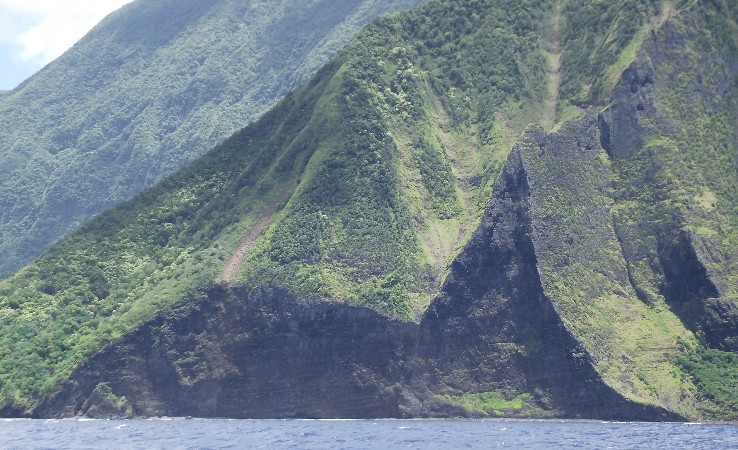
After leaving Maui we sailed along the northern shore of Moloka'i. We wanted to see the incredible waterfalls falling through the steep canyons. 2011 is a drought year for Hawai'i, and its summer, so there weren't a lot of waterfalls but what we saw was great. 


Kalaupapa - the site of Hawai'is Leper Colony

In the center of the north shore of Moloka'i is a peninsula which creates a protected anchorage and a very isolated place to live. In 1848 the state of Hawai'i purchased this area and in 1866 began exiling victims of Hansen's Disease (Lepers) to the area. Although a treatment was available in 1930 some afflicted people chose to stay in the colony. Today approximately 60 people still live there.


Northwest end of Moloka'i

Papohaku Roadstead

Moloka'i may be the most Hawai'ian of the islands - it has the largest percentage of native Hawai'ians. Of its 7,400 permanent residents, almost half are at least 50% Hawai'ian blood. Moloka'i has been virtually ignored by developers and only one small resort has been built at the Papohaku Roadstead. We anchored here one night and watched a few people stroll along the lovely beach and climb over the rocks. This was a nice alternative to the "Club-Med" type resorts on the other islands.


We ran into our share of squalls.


Our last anchorage in Hawai'i was the Kane'ohe Bay Yacht Club on O'ahu.

Chinaman's Hat Island in Kaneohe Bay on O'ahu


The incredible land forms of Kane'ohe Bay
 

Kane'ohe Bay Yacht Club

Kane'ohe Bay Yacht Club was our favorite with its beautiful lawns, pool, palm trees and friendly people.


Sonia's beautifully executed med moor put us next to our new friends on Cadence.


Sonia was facinated with some striking red-headed birds that perched near the boat. They turned out to be a red-crested Cardinals also known as the Brazilian Cardinal.

Bishop Museum located in Honolulu.


We spent an entire day at the Bishop Museum. This is the building housing Hawi'ian artifacts and models of marine animals. In the center is an example of the double canoe, totems and a typical "precontact" Hawai'ian house.

There were some really unusual items which I thought would be interesting to share.

These Hawai'ian capes are bright red and yellow. They are made from the feathers of the red iiwi bird (Vestiaria coccinea) and the yellow feathers of the oo bird (Moho spp.) . At first I was very disturbed at the idea of killing so many birds to make these but then I read that the birds weren't killed. The Hawai'ians developed a way to catch the birds and pull out some feathers and then let them go.
 These head pieces are also made from bird feathers.


"This ahuula belonged to Queen Emma and was worn when a child at the Royal School. It is made up of red iiwi (Vestiaria coccinea) feathers and black and yellow oo (Moho spp.) feathers. It has a background of red iiwi feathers. Two pairs of yellow oo crescents, one pair running close to the neckline. Two pairs of yellow oo half crescents are on both the left and right front edges. A band of yellow oo runs along its lower border. A thin band of alternating black and yellow oo sections run along the neckline. Its net backing is made of olona (Touchardia latifolia) fiber."

from the Bishop Museum website: http://bishopmuseum.org/

This prized symbol of chiefly rank in old Hawai‘i is made of a carved whale tooth, also known as whale ivory, strung on thick strands of finely braided human hair.

I found it odd that there were so many of these on display and we typically think of Hawai'ians having long hair. All the pictures in the museum of women showed them with short hair.

The Hawaiians were fierce warriors. They didn't have metal so their weapons were made from wood and animal parts.


"Some of the most fearsome weapons in the arsenal of a Hawaiian koa (warrior) were ones studded with the niho niuhi, the teeth of the man-eating shark. The handles were typically of hard wood, such as kauila, and slots were scored into them to imbed the teeth. The teeth were fastened to the handle by lashings pulled through small drilled holes."

from the Bishop Museum website

This sperm whale model hangs from the ceiling. 


The back side of the sperm whale model showing it's mouth.


We were told that the whale that surfaced next to our boat was probably a sperm whale. The sperm whale reaching up to 69' and 58 tons is a toothed whale. They feed at great depths ( up to 10,000 feet) where they consume bottom-dwelling sharks, squid, octopus, large fish and other sharks.

Adjacent to the Hawai'ian Hall is the Castle Memorial Building that houses special displays. We were fortunate to catch a really interesting one.

Dinosaurs Unearthed - Feathered Discoveries

"In the last decade, the discovery of feathered dinosaurs in Liaoning Province, China has shifted popular thought and caused paleontologists to re-evaluate the appearance of theropod dinosaurs around the world.
The fossils discovered in Liaoning were exceptionally well preserved, which has allowed scientists to draw significant conclusions about feathers, color, and environmental influences.
The discovery has drawn the fascinating connection between ancient dinosaurs and modern birds. Scientists have found that feathers first evolved as a means of warmth and display and later became specialized to the extent that flight was possible."
from: http://bishopmuseum.org/exhibits/onexhibit.html


 Life-size animated models demonstrated the new concepts of what scientists think dinosaurs looked like.


We thoroughly enjoyed our day at the Bishop Museum and agree that it is a must see if you visit O'ahu.

Now we are safely back in Blaine and preparing to head north to Telegraph Harbor on Tethis Island in Canada for the All Catalina Rendezvous.

I will be making one more blog entry - a wrap up of our route, our milage, what worked and didn't and what broke! Don't miss it.

Sunday, July 31, 2011

Port Angeles Welcome

WindWatcher greets Comocean as we approach Port Angeles.

We arrived at Neah Bay on Wednesday, July 27th around 11pm. Our journey is complete. Our voyage from Hawai'i was 3,174 miles. Neah Bay was empty of anchored boats this time and anchoring in the dark was fairly easy. Finally we could sleep all  night. Thursday was a day to clean up the mess from a three-week passage and then rest.

Friday morning at 6:15am we were under way to Port Angeles. A few miles from Port Angeles Greg noticed a vaguely familiar boat. It circled around and approached us. Lo and behold, there were our friends Chuck and Jan on WindWatcher -  another Catalina 42. They had sent an email, which we hadn't received, telling us that they were starting their adventure and would try to intercept us as we passed in the Straight of Juan de Fuca. What a pleasant surprise! They joined us at the public dock  in Port Angeles for the night and we shared dinner on Comocean. Chuck and Jan are headed to San Diego where they will prepare their boat for a cruise to Mexico, the Caribbean and beyond. We shared our new cruising knowledge and said goodbye in the morning.


It was so nice to share our regular bed. Our passage berth was the aft starbd berth. The cushions, abandon-ship bag and various bags of stuff kept us in place. Cinnamon was a frequent bunkmate. I had to be very careful when I rolled over because would end up under me. Once we were at anchor and back in our regular bed he didn't need us for security and we sleep without him now.


Cinnamon picked up some unusual habits while we were at sea. When he didn't eat or drink during the first week I had to resort to some unconventional methods to encourage him. He developed a fondness for drinking his water from a tumbler in the bathroom. I guess it was the traces of toothpaste that made it so special.
We visited the NOAA center for the Olympic Coast Nat. Marine Sanctuary in Port Angeles. It was smaller than the Hawai'ian center in Hilo but filled with lots of interesting exhibits and two knowledgeable workers. I gathered some materials to share with my Semiahmoo friends and the next C42 Rendezvous.

Now we are headed to Dungeness Spit which is a little southeast of here. We have our fishing/crabbing license in hand and we are eager to get back at it!

Wednesday, July 27, 2011

Land Ho!

On July 27 we are starting to see boats on the AIS. 50 miles off shore and there 8 ships around us. At 7pm, 25 miles out, I climb into the cockpit and see land - Vancouver Island. By 11pm we should be at anchor in Neah Bay. But, as they say on the Pacific Seafarer's Net, "It's the crunchy bits around the edges that are the dangerous parts." I don't anticipate a problem though. We will be arriving after dark but we have been there before and know what to look for.
-----
At 7/27/2011 4:31 AM (utc) our position was 48°29.63'N 128°45.56'W on course 091T at 6.6 knots.

----------
radio email processed by SailMail
for information see: http://www.sailmail.com

Wednesday, July 20, 2011

1,000 Miles to Go

Another nice day, zipping along at 6-7 knots we are cranking out 150 mile days like clockwork. But, lest we get complacent, there are 3-4 days of heavy wind/sea coming day after tomorrow from a low moving down the coast. We're past 2,000 miles with about 1,000 to go. Cool enough at night now that we've reassembled the Pacific-Norwest configuration with an enclosed cockpit. Still on spinnaker but that comes down tomorrow p.m. unless Sonia turns off the power earlier**. She is prep'ing meals ahead for the bad weather.
Greg

**
The other morning I was at the end of my 6 hour watch and hungry. I sat down on the settee across from the sink with a bowl of cereal. The next thing I know the boat rounds up and chaos ensues! Greg wakes up and we both rush out to the cockpit. I couldn't get the rudder to respond and the instruments were all off. I wondered how we could have blown a 300A fuse. First Greg checked the steering to make sure it was okay and then started to work on the electrical problem.
Once solved he demanded to know where I was when all this happened. I told him that I was sitting down trying to eat my cereal. AHA! What? "You turned off the master switch"! The switch was right under me and apparently I kicked it and didn't realize it. Oh, well. That was better than something breaking and besides it gave Greg something to raze me about.
Sonia
-----
At 7/20/2011 12:05 PM (utc) our position was 46°38.13'N 151°07.09'W on course 087T at 6.7 knots.

----------
radio email processed by SailMail
for information see: http://www.sailmail.com

Friday, July 15, 2011

Flying the Spinnaker

4 am on a beautiful cloudy early morning; 1300 miles north now. Fishing is good under the full moon and the birds (I can't tell if they are storm petrels or shearwaters) are flying around the boat while keeping up a lively conversation. They have Cinnamon's attention.

We deployed the spinnaker yesterday and then we ran out of wind in the afternoon. I knew it was too good to continue. From 8 knots to 3, and then zero is hard to take. The spinnaker kept collapsing so we finally dropped it and motored for a while. Sometime during Greg's watch he deployed it again, BY HIMSELF, and probably without his vest and tether. We are flying again - 6.6 knots in 11K of wind. My spirits are lifted.
-----
At 7/15/2011 9:28 AM (utc) our position was 41°36.95'N 164°47.17'W on course 007T at 6.6 knots.

----------
radio email processed by SailMail
for information see: http://www.sailmail.com

Thursday, July 14, 2011

1000 Miles

There's a full moon hanging over a bank of dark clouds to the southwest this evening. The wind is soft and the seas are rolling gently with less than a one foot swell. It's a pleasant night watch.

We have passed the 1,000 mile mark and tonight we will start heading northeast as we round the Pacific high. Less than 2,000 miles left. There are at least four boats making their way back to the Pacific Northwest now and we each seem to have our own unique idea of how to do it. One poor captain was congratulated last night for finding the exact center of the high when he reported his position, wind (0)and boat speed (0)to the Pacific Seafarers' Net - he apparently doesn't have access or understanding of GRIB files. They have really made a difference for making safe and faster passages.

This passage hasn't been as bleak as the passage from Baja to Hawai'i. We see birds everyday - maybe only one or two shearwaters, but two nights ago we were surrounded by a flock of over a dozen black-footed albatross. The flying fish are plentiful out here and are amazing to watch. One flew into the cockpit and smacked Sonia on the leg - he was a beautiful little thing but none the less, he became cat food.

We are enjoying this brief calm before we start the sleigh ride across the high in the next day or two.
-----
At 7/14/2011 9:19 AM (utc) our position was 39°30.79'N 164°56.79'W on course 356T at 7.8 knots.

----------
radio email processed by SailMail
for information see: http://www.sailmail.com