 |
| Southern cove anchorage at Ensenada Grande |
Isla Partida
One of our favorite anchorages is Ensenada Grande on Isla Partida. Ensenada Grande is a three-lobed bay that provides good anchorage, beautiful scenery, hiking and snorkeling. We spent two nights in the northern cove parallel to the cliff, one night in the middle cove and two nights in the southern cove utilizing two anchors (our favorite, where we had stayed when we previously chartered).
The northern cove was the least scenic but was the best for watching stingrays. The rays, which we never could positively identify, would shoot out of the water flying several feet into the air while flapping their “wings” (their flippers actually). Some would fly forward and some did somersaults. We watched them for four days. Several would be flying at once and it could last for 30 minutes. We wondered if they were playing, feeding or fleeing. I was able to find out that rays are the favorite food for sharks. As we were returning to
La Paz I noticed a rather large disturbance in the water ahead. As we drew nearer I began to see rays flying and then I noticed about 30 small, dark fins cutting through the water around the rays. I am not positive, but I would bet they were sharks. What a sight to see. I couldn’t capture a picture of the rays flying but I did get one of the sharks; if you look closely you will see their fins.
 |
| Sharks after the rays. |
I really wanted to stay in the southern cove near the beach again. It was one of the high points of my first charter trip to the
Sea of Cortez. Greg was hesitant due to the wind and the position of two other smaller boats that were already in the cove. After a couple of passes he decided we could do it if we deployed two anchors, but we couldn’t get as close to the beach as I wanted.
 |
| Northern shore of southern cove. |
 |
| Brown Footed Booby |
The turquoise water is full of small fish and is surrounded by cave studded cliffs and lush desert vegetation - perfect bird habitat. In the cove just south of Ensenada Grande is a special treat for birders - a blue footed booby rookery. We motored by the site but they had already left. I hope to see them when we return in the spring. I did spot two brown footed boobies however that were fishing around our boat. They are so fast it was difficult to get a picture that was in focus.
 |
| Table cloth formation from wave action. |
 |
| Wonderful snorkel spot in the south cove. |
We snorkeled along the base of the northern cliff. The water is 70 deg now and we can only manage 30 minutes before hypothermia starts in. We saw several new species and some fairly large fish (about 18” long). I’m still searching for a reef fish book so that I can id them.
 |
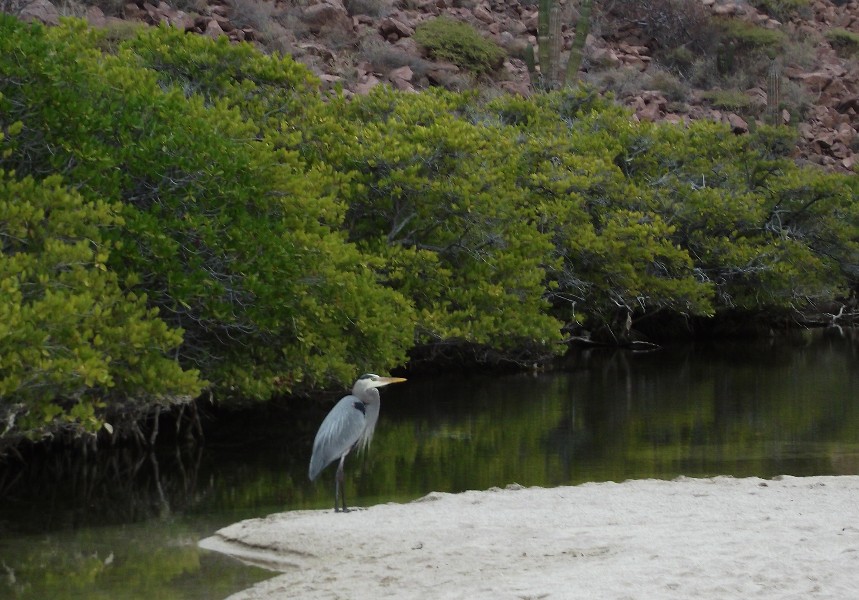
| Great Blue Heron |

Oysters used to be abundant in this area but were over fished. Note how small they are compared to our oysters. Hopefully they will rebuild their numbers now that Mexico is more environmentally aware.
 |
| The beginning of another hike. |
Another “hike” leads from the white sand beach of this cove across the island to the eastern shore. It follows a rocky arroyo (stream bed) ending at a 450 ft cliff that looks down on the sea. This hike was 5 miles, and like the first, had very little in the way of a trail. It also required scrambling over boulders the size of VW beetles.
It was amazing how lush the arroyo was. There were several species of leguminous trees and some wildflowers and seed pods were still visible. Plants were growing miraculously out of rocks. I guess they live on whatever water falls or condenses on them.
 |
| Water course thru the arroyo shows strength of water. |
 |
| Looking down at our anchorage. |

We saw the only mammal mentioned on the information sign - the tiny antelope ground squirrel. We also saw one snake - which I think was a mountain gartersnake. It was lying along the side of a rock and quickly moved away as Greg approached.
It was 70+ with the sun overhead. I gave up about 4/5ths of the way up; I figured I had better save my strength. I rested in a lovely little shaded area. Greg went on to the cliff and took pictures and as you can see the view was spectacular. We made our way back down without incident, looking forward to some nice margaritas.
 |
| Shady resting place in the arroyo. |
 |
| East side of Isla Partida |
 |
| Looking south from atop the cliff. |
 |
| Looking north. |
 |
| Los Islotes and Sea Lion Rookery |
We are returning to
La Paz for mail and to reprovision. At the northern end of Isla Partida is a wonderful place called Los Islotes, a rocky outcropping with a sea lion rookery. Here you can swim with the sea lions and their pups. I did this on our first charter with a friend.
Greg will join me this time when we head north again, if the water temp doesn’t prevent it.


 Oysters used to be abundant in this area but were over fished. Note how small they are compared to our oysters. Hopefully they will rebuild their numbers now that Mexico is more environmentally aware.


 We saw the only mammal mentioned on the information sign - the tiny antelope ground squirrel. We also saw one snake - which I think was a mountain gartersnake. It was lying along the side of a rock and quickly moved away as Greg approached.


